Amaia Salazar
Ofrenda a la tormentaAmaia Salazar is a police inspector whose investigation of Elena Ochoa’s death and the pattern of suspicious infant deaths brings professional reasoning into collision with family history, buried violence, and her own persistent fears. She works by testing connections against evidence, but refuses to dismiss an intuition simply because it reaches beyond what a case file can establish.
Identity and Investigative Method
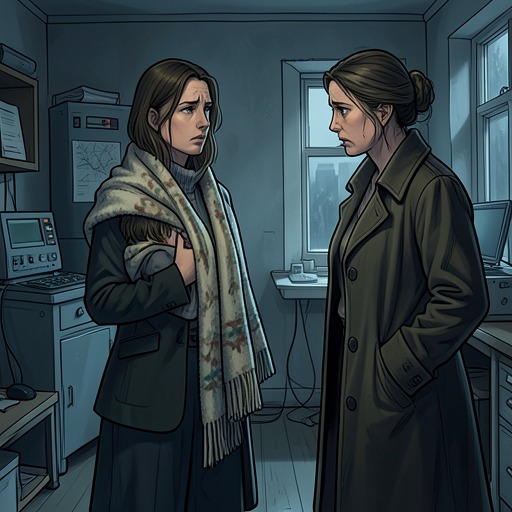
Amaia’s work is defined by a willingness to enter situations carefully and on their own terms. At one detention, she tells Iriarte that she will speak to the man alone: without a uniform, and as a woman, she expects her presence to feel less hostile. Iriarte withdraws to an adjoining room, where he can see and hear what happens, while Amaia stands silently before the prisoner before asking whether she may sit. Her approach combines attention to the conditions of an encounter with deliberate restraint; she does not treat authority as a substitute for establishing contact.
That balance also shapes her investigation beyond the interview room. She spends twenty minutes watching a house from her car, its dark-shuttered facade blurred by rain and condensation, before intercepting a young man carrying a flat package to the door. In another inquiry, she follows Elena Ochoa’s warning because she believes the house connected to her mother may hold answers. When Elena insists that speaking would put her in danger, Amaia presses her to help, making plain that the search is not abstract: her mother is free, and Amaia needs to find the house. The investigation begins where professional curiosity and personal urgency become difficult to separate.
From Family History to a Pattern
Elena Ochoa’s account gives Amaia a way to connect the present investigation to an older history. She explains to her colleagues that Elena had been a friend of her family, especially of Rosario, and had described a sectarian group that settled in a farmhouse at Orabidea in the late 1970s and early 1980s. Its communal gatherings, initially cultural and spiritual, had turned toward occult practices and animal sacrifice; the suggestion of human sacrifice was enough to make Elena leave. The group continued for a time after her departure. Amaia has now found the house, renovated into a guarded mansion, and learned that its wealthy, retired owners belonged to the original group. A neighbor identified Berasategui’s car there, and the couple acknowledged knowing him, but answered Amaia’s questions about their relationship by putting a lawyers’ card in her hand.
The house matters because it draws together details that had seemed separate. Amaia recounts that Berasategui accompanied Rosario after they left the clinic, but the known timeline leaves an unexplained interval before the attack on her aunt and the abduction of Ibai. The father’s house does not fit, and Amaia suspects that Rosario and Berasategui took shelter elsewhere. She then lays out the older group’s interest in sacrifices of animals and the possibility of sacrifices involving newborns or very young children. The mansion’s owners said that their daughter died under two while the family was travelling in the United Kingdom; Amaia finds no death certificate, hospital record, or evidence of the journey. A witness has also placed Berasategui and his car at the property more than once.
Amaia tests that history against the records of infants who died in their sleep. Routine examinations had classified the deaths as cot death, but she focuses on girls and identifies her sister and three other cases whose families had also drawn concern from social services. The parents’ behavior had seemed troubling, and the families shared a connection to the house, the group, and the wealthy lawyer couple, who had also lost a young daughter. This is not yet proof of a single cause; it is a set of converging links that Amaia treats as grounds for further inquiry. She argues that the unexplained deaths, the family connections, and Berasategui’s presence at the house must be considered together rather than dismissed as coincidence.
Her insistence on extending the inquiry brings professional conflict into the open. After bypassing the French judge, Amaia is reprimanded by the judge herself, who says she has put her in a difficult position and will inform Amaia’s superiors. Humiliated, Amaia calls Markina, but he ends the call before she can reach him. When he later challenges her decision, she admits that she acted without consulting him and that she made a mistake; she explains that two children had died at the same time without autopsies, while their father was connected to Berasategui, the lawyers, and the house. Her reasoning is an attempt to secure a new investigative lead, not a claim that suspicion alone establishes guilt. That distinction becomes central to her work: she accepts responsibility for procedural overreach without abandoning the evidence that first made her question the official account.
A Geography of Loss
Amaia turns a collection of infant-death files into a spatial investigation when she reworks the maps and photographs Jonan had been assembling. His scenario file lists the addresses of babies previously investigated and includes Amaia’s sister, but leaves out Yolanda Berrueta’s children. Amaia plots the cases again, initially leaving Ainhoa off the map, and joins the locations on either side of the N-121. The familiar possibility of a serial offender using a major road to escape does not fit what she sees. On a fresh map, the marks form a line when the Ainhoa cases are removed; a blue trace identifies the Baztán River as the feature linking them. The pattern runs from Erratzu through Arraioz, Elbete, and Elizondo, then reaches Oieregi with Haizea’s case. The river, rather than the road, becomes the investigation’s organizing geography.
The map does not by itself establish a cause, but it changes the scale and direction of the inquiry. Amaia asks colleagues to look for a behavioral pattern among the families whose daughters died in infancy or before the age of two. The families had been in poor financial circumstances around the time of the deaths and later experienced improved fortunes; in several cases, parents had said that life would get better from then on. The repeated detail of female victims, together with the family histories and the earlier concerns raised by social services, gives the pattern a sharper outline without converting it into proof. Amaia also links the current disappearance of the Esparza child’s body to the older cases, arguing that the disappearance renews the investigation even though she has no way to confirm her suspicions about the child buried at Ainhoa or obtain another judicial inspection there.
The work of testing the pattern is slow and administrative as well as interpretive. A search through baptism records requires the investigators to identify each child’s parish and speak to its priest, who alone can consult the records and may only be available during parish office hours. In Hondarribia, that process reduces four possible cases to two: one was a German child who died while travelling with her parents, and another had been baptized. When Amaia narrows the wider search to settlements beside the river, the working list includes one case in Elizondo, one in Oronoz-Mugaire, one in Narbarte, two in Doneztebe, and two in Hondarribia. These results are not a finished account of the deaths; they are a more disciplined boundary for the next stage of inquiry.
Amaia then asks that older cases be added in a different color: the girl at Argi Beltz, her own sister, the girl at Lesaka, the daughter of the lawyers Lejarreta y Andía in Elbete, and the child in Erratzu whose father confronted the forensic doctor. Together, the marks trace the river from its source toward its mouth, where it takes the name Bidasoa. Iriarte sees the pattern taking shape behind her. The map’s force lies in its accumulation: present and historical cases, separated by years and different official explanations, now appear along one continuous course. Amaia uses that geography as a testable investigative lead, not as a supernatural explanation or a substitute for evidence.
Intuition, Bereavement, and the Tomb
Amaia’s method increasingly depends on holding two kinds of knowledge in view at once. She remains a trained investigator, but has come to believe that rational procedure and intuition can work together rather than cancel each other out. In the forest, she reflects on the warning that an alarm should not be ignored, and on her conviction that Rosario’s threat has not ended. The fear is not merely an idea: after a nightmare in which Rosario came close enough to be seen and smelled, Amaia wakes with her body still registering pain and restraint, and has to scrub away the remembered trace of her mother. The dream’s physical force leaves her wondering whether such terror can cross the boundary between sleep and waking, as in the legend of Inguma. Her uncertainty does not become proof; instead, it sharpens the questions she brings back to the investigation.
Jonan’s murder turns that investigative partnership into a personal loss. When Amaia reaches the apartment, Zabalza tries to keep her from entering, but she draws her weapon and makes him step aside. Inside, she finds Jonan on the floor, shot twice, and collapses beside the body as grief overwhelms her ability to breathe. His death also changes what information she can access and how urgently she must recover it. A church contact tells her that Berasategui maintained a detailed encrypted file of his cases, including the Esparza matter, and that Vatican authorities had taken the files after his arrest. Amaia rejects the effort to soften Jonan’s death as a mere passing, insisting that he was murdered and that the investigation belongs to those pursuing the crime.
The files Jonan left behind become a continuation of his work. Amaia enters her email address and uses the clue Marc gave her to open the account, then examines the stored photographs and case materials. Jonan had assembled pictures of her sister’s empty coffin, the ancient and more recent bones found at Arizkun, and Rosario’s coat recovered from the river; he had also photographed the judge’s secretary meeting Yolanda Berrueta. His case map includes Amaia’s sister among the infant deaths but omits Yolanda’s children. When Amaia plots the locations again, the cases form a river-linked line rather than a pattern around the N-121. The combination of a map, the files, the ritual language of an offering, and the empty coffins gives her a new way to connect evidence that had been scattered across separate investigations.
Amaia’s subsequent reasoning widens from the places of death to the people who joined the cases. She asks the team to compare the families, noting that the victims were girls, that several families had been financially strained when the children died and prospered later, and that some parents had spoken as if life would improve after the deaths. She also argues that the Esparza child’s missing body makes the case active again. Berasategui’s connections to the families, his treatment of victims, and evidence of cannibal practices make it necessary, in her view, to consider ritual activity without treating it as established fact. Elena Ochoa’s account places animal sacrifice at Argi Beltz; a trusted informant describes similar practices at Lesaka and a leader moving between the groups. Amaia connects that history to Ainara Martínez Bayón, whose parents’ claim that she died abroad is unsupported by a death certificate, autopsy record, burial record, or evidence that she left Spain. The gatherings hosted by her parents also drew Berasategui, Nurse Hidalgo, Yolanda Berrueta’s former husband, and Valentín Esparza, under a stated purpose of helping families grieve.
At the cathedral in Pamplona, Amaia presses Sarasola to explain the pattern behind Berasategui’s murders. She describes the doctor as an instigator who used his psychiatric work to find vulnerable men, manipulate their anger, and make them enact violence against a specific class of victims: women from Baztán. Berasategui then took the victims’ arms as trophies, which Amaia understands as offerings connected to the creature whose name he adopted. Her attention to the victims’ selection prevents the investigation from stopping at the men who physically carried out the killings. She further identifies Víctor Oyarzabal, known as Basajaun, as a man who attended therapy in Irún and asks whether Berasategui treated him. Sarasola’s confirmation shows that the priest possessed relevant information he had not volunteered, deepening Amaia’s distrust of controlled disclosure even among supposed allies.
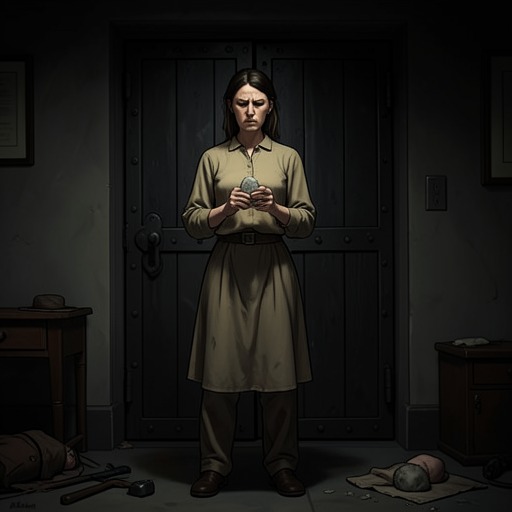
Her relationship with Markina remains entangled with the investigation. After days of unanswered calls and growing difficulty between them, Amaia arrives at his door having rehearsed an explanation and a request for help. Markina draws her into a kiss, and the prepared words disappear. The moment of intimacy does not resolve the conflict that follows. In the family tomb, Amaia finds the bloated, decomposing body of the Esparza girl among the remains of at least twenty creatures, alongside a very white skeleton missing an arm. The discovery gives physical form to the pattern of stolen or substituted remains and to the trophies she has been tracing. Amaia falls to her knees, overcome by revulsion, anger, and shame, then confronts Markina with her belief that he knew his father was responsible and concealed it. The tomb turns her accumulated inferences into a confrontation with human remains—and with the possibility that the person closest to her has withheld the truth.